
This guide answers the question most Ipswich and Brisbane homeowners ask before buying a split system: what size air conditioner do I need? It’s written for anyone planning a new or replacement unit, with a sizing chart you can use before you get a quote.
Plenty of split systems that struggle through summer have nothing wrong with them except their size. A 2.5 kW head above the lounge door runs flat out at 3pm and the room still sits at 29 degrees. If you’re planning a split system installation in Ipswich or Brisbane, getting the size right first saves money on the unit and every power bill after it.
What size air conditioner do I need?
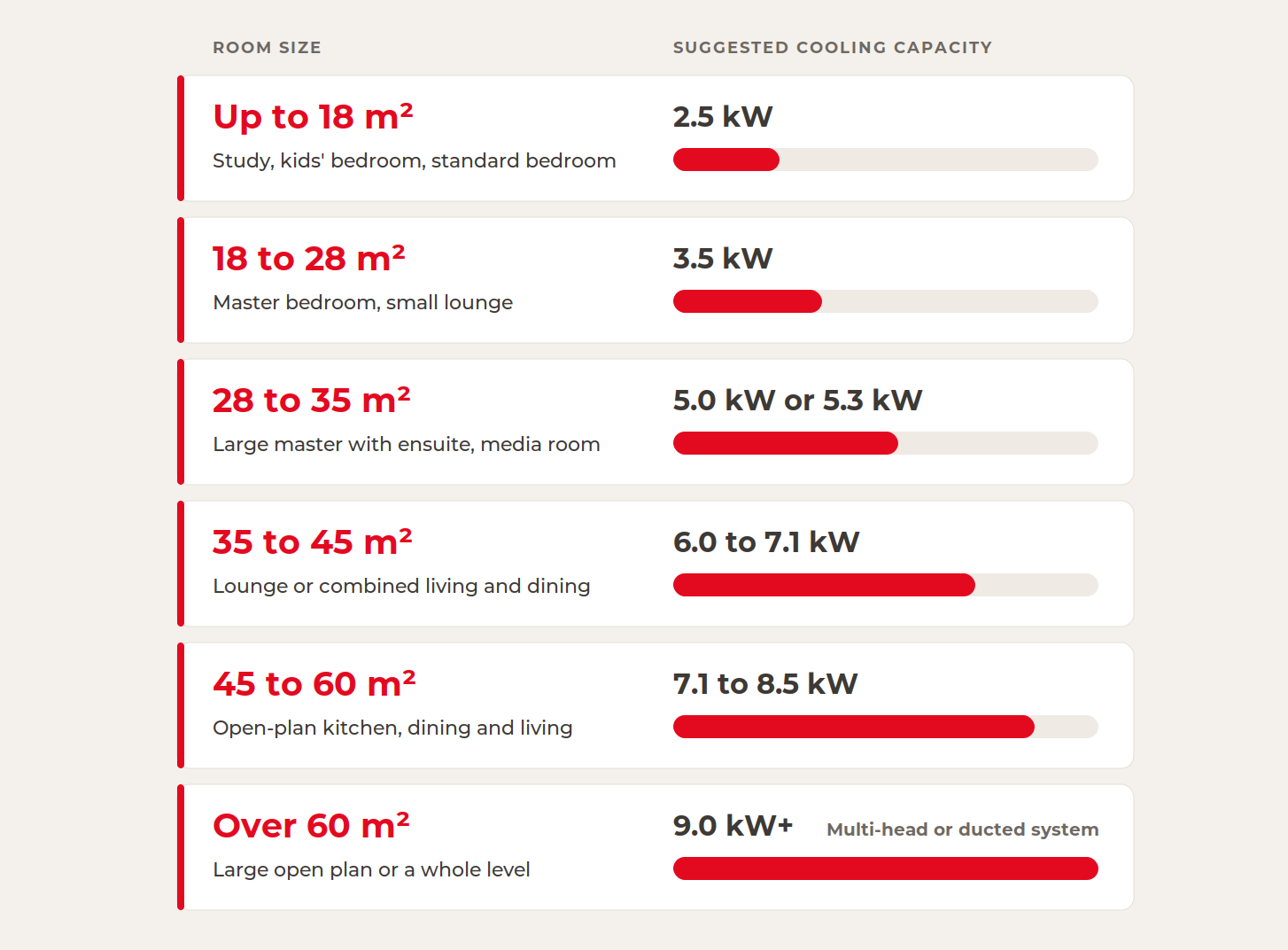
For most South East Queensland homes, allow about 0.12 to 0.16 kW of cooling per square metre of floor. That puts a 2.5 kW split in a bedroom up to 18 m², a 3.5 kW unit in rooms of 18 to 28 m², and a 7.1 to 8.5 kW system in open living areas of 45 to 60 m².
Those numbers assume a standard 2.4 m ceiling, an insulated roof and no heavy afternoon sun.
To get your floor area, measure the length and width of the room in metres and multiply them. A 4 m by 4.5 m bedroom is 18 m². For open-plan spaces, measure everything the unit has to cool, including any kitchen or hallway with no door between them.
Split system sizing chart by room size
The chart assumes a typical Ipswich, Brisbane Southside or Logan home with ceiling insulation in place.
| Room size | Typical room | Suggested cooling capacity |
|---|---|---|
| Up to 18 m² | Study, kids’ bedroom, standard bedroom | 2.5 kW |
| 18 to 28 m² | Master bedroom, small lounge | 3.5 kW |
| 28 to 35 m² | Large master with ensuite, media room | 5.0 kW or 5.3 kW |
| 35 to 45 m² | Lounge or combined living and dining | 6.0 to 7.1 kW |
| 45 to 60 m² | Open-plan kitchen, dining and living | 7.1 to 8.5 kW |
| Over 60 m² | Large open plan or a whole level | 9.0 kW or more, multi-head or ducted |
Not sure how your room measures up? Add the room size and a couple of photos when you request a quote. It gives us a head start on the right capacity before we measure up.
What pushes a room up or down a split system size
These details can push the same floor area up or down a size:
- West-facing glass. A large sliding door catching the afternoon sun can add close to a full size step. External blinds or low-e glass win some of that back.
- Ceiling height. Anything above 2.7 m means more air to cool. Raked ceilings in newer Springfield Lakes and Ripley builds are a common example.
- Roof insulation. An older timber Queenslander in Tennyson or Yeronga with patchy ceiling batts loses cool air fast. Upstairs rooms under a dark tin roof are the hardest to cool.
- Open doorways and stairwells. Cold air sinks, so a lounge that opens onto a stair void pushes cooling away from where you sit.
- Heat made inside the room. A kitchen with the oven on or a home office running two monitors both add load.
- Suburb. Ipswich and western areas like Karalee and Brassall often run a few degrees hotter than bayside suburbs on summer afternoons, so we size with that in mind.
If two or more of these apply, go up one size from the chart.
Is it better to oversize or undersize an air conditioner?
Slightly oversized is safer than undersized in South East Queensland, but only by one step on the chart. An undersized unit runs flat out and still can’t keep up on a hot afternoon. A heavily oversized one cools fast but leaves the room clammy.
- Undersized: the compressor runs at full speed all afternoon on a 35-degree day, so it wears faster and your power bill climbs.
- Heavily oversized: the unit hits the set temperature in minutes, then shuts off before it has pulled enough moisture out of the air.
In a humid Brisbane February, that sticky feeling is often the first sign a unit is too big. The Australian Government’s Energy Rating guide to choosing the right air conditioner size makes the same point.
Converting BTU and horsepower to kW for split systems
Australian units are sold in kilowatts, but older units and overseas listings often use BTU or horsepower:
| BTU or horsepower | Approx. cooling capacity | Suits a room of about |
|---|---|---|
| 9,000 BTU (1 hp) | 2.6 kW | Up to 18 m² |
| 12,000 BTU (1.5 hp) | 3.5 kW | 18 to 28 m² |
| 18,000 BTU (2 hp) | 5.0 kW or 5.3 kW | 28 to 35 m² |
| 21,000 to 24,000 BTU (2.5 hp) | 6.0 to 7.0 kW | 35 to 45 m² |
Horsepower is a loose label that varies between brands, so always check the kW figure on the Energy Rating label before you buy.
When one split system isn’t the right fit
Once a space goes past about 60 m², or you want to cool three or more bedrooms, a single wall-hung unit runs out of reach. The two usual options:
Multi-head split system
One outdoor unit runs multiple indoor heads, each sized to its own room. It suits a few bedrooms without lining the side of the house with outdoor units.
Ducted system
For whole-home cooling with zones, ducted air conditioning for Ipswich and Brisbane homes is usually the better call, especially in a two-storey house.
What we check before recommending an air conditioner size
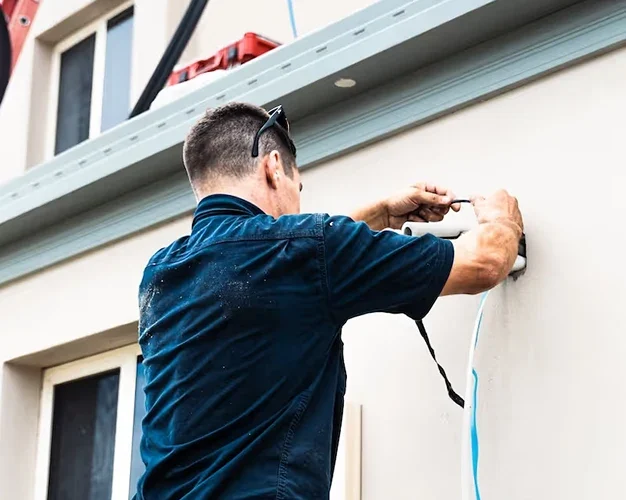
A chart gets you close. When BRIX Electrical & Air quotes a split system, the site visit covers:
- The room’s measurements, ceiling height and which way the windows face
- Where the head unit and outdoor unit can sit, and how long the pipe run will be
- The condensate drain path, so water doesn’t end up running down your wall
- Your switchboard and circuit capacity, since larger units often need their own circuit
Our licensed team handles the electrical side in-house, so there’s no waiting on a second contractor to run a new circuit. We’re a Mitsubishi Electric Diamond Dealer and also install Daikin, Fujitsu and Panasonic, which means the recommendation comes down to your room and your budget.
If you’d like Brodie and the team to measure up, request a free air conditioning quote or call 07 3060 9100. We’ll tell you the size you need, even if it’s smaller than the one you had in mind.